

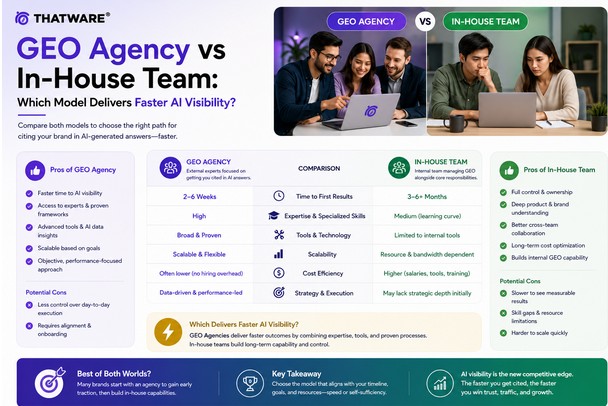
It’s one of the oldest decisions in marketing: build internal capability or bring in outside expertise? The answer has never been a clean one, and it isn’t for GEO either. But the specific characteristics of GEO work — the skills required, the pace of the field’s evolution, the cross-functional nature of the work — push the analysis in a particular direction for most organizations.
This isn’t a pitch for one model over the other. It’s an honest look at what each model actually delivers, where each has genuine advantages, and how to think about the right approach for your specific situation.
What GEO Actually Requires
To evaluate the build-vs-buy question fairly, you need to be clear about what GEO competently executed actually requires. It’s not a single skill — it’s a combination:
Strategic GEO analysis: Prompt landscape mapping, competitive AI citation analysis, entity health auditing. This requires a deep understanding of how AI systems evaluate and cite content — knowledge that’s evolving rapidly as the systems themselves change.
Technical SEO with a GEO lens: Structured data implementation, schema markup, entity optimization, international technical considerations. This is specialist technical work that requires hands-on experience.
Content strategy and production: Understanding what types of content AI systems prefer, writing and editing content for AI extractability, content architecture for topical authority.
PR and earned media: Building external citation footprints through media relations, digital outreach, and third-party platform development.
GEO-specific measurement: Prompt tracking methodology, citation rate analysis, share of AI voice calculation — measurement approaches that don’t come standard in marketing analytics tools.
Finding one person who genuinely covers all of these at a high level is extremely rare. Building a team that covers them all requires multiple hires at a time when GEO-experienced talent is scarce and expensive.
The In-House Argument
There are real arguments for building internal GEO capability, and they shouldn’t be dismissed.
Deep product and category knowledge. No agency, however good, will ever know your product, your customers, and your competitive landscape as well as your internal team does. GEO strategy that’s genuinely aligned with business context requires that knowledge.
Speed of execution. Internal teams can move faster on certain types of work — particularly content that requires deep product expertise or frequent updates based on internal developments.
Accumulated institutional knowledge. Over time, an internal team builds GEO knowledge specific to your brand, your customers, and your competitive environment that compounds in ways external relationships don’t.
Control and alignment. Some organizations prefer having GEO strategy owned internally, particularly when it intersects closely with sensitive competitive positioning or brand voice decisions.
The in-house model is most defensible for large organizations with significant marketing teams, mature content operations, and a realistic runway to develop GEO-specific expertise over eighteen to twenty-four months. For smaller organizations or those that need results more quickly, the build timeline is a genuine constraint.
The Agency Argument
The agency model has specific advantages that are particularly pronounced for GEO given where the field is right now.
Existing expertise. The best GEO agencies have already invested in building the specialized knowledge, tools, and processes that would take an in-house team a year or more to develop. That gap matters if you’re trying to build AI citation presence while the competitive landscape is still relatively uncrowded.
Cross-client learning. Agencies working across multiple clients in a field see patterns and develop best practices that individual in-house teams can’t. A GEO agency that’s worked with twenty brands has learned what works and what doesn’t in ways that inform their work with client twenty-one.
Full-stack capability. A good GEO agency brings strategy, technical implementation, content expertise, and measurement together in a coordinated way. Building that internally requires multiple hires and significant coordination overhead.
Speed to baseline. For organizations starting GEO from scratch, an experienced agency can compress the time to a functional baseline significantly — getting entity optimization, schema implementation, content architecture, and measurement infrastructure in place in months rather than the year-plus that internal ramp-up typically requires.
The Hybrid Reality
Most organizations that do GEO well eventually land in some version of a hybrid model — external expertise for specialized functions, internal ownership of strategy and brand alignment.
The most common effective structure: an internal GEO lead or owner (often within the SEO or content function) who understands the strategic picture, manages the agency relationship, and ensures GEO work is integrated with broader marketing efforts, combined with an external partner providing specialized expertise in technical optimization, prompt landscape analysis, and measurement.
This hybrid approach gets the best of both models: external depth in the specialized skills, internal depth in brand and business context.
GEO Agency Comparison: What to Evaluate
If you decide to bring in external expertise, the agency comparison question is genuinely important. Not all GEO agencies are equal — and some are simply traditional SEO or content agencies that have rebranded without substantively changing their approach.
Things that distinguish genuine GEO expertise from rebranded SEO services: a clear methodology for AI citation tracking (not just organic traffic and rankings), demonstrated experience with entity optimization (not just on-page SEO), a PR and earned media component to their citation building approach, and case studies with actual AI citation rate metrics, not just traffic metrics.
Best GEO agency selection should be based primarily on evidence of results in comparable contexts, methodological depth under scrutiny, and a clear integration plan for working with your existing marketing function.
Which Model Is Actually Faster?
For most organizations asking this question, the honest answer is that the agency model delivers faster initial results — particularly for the foundational work of entity optimization, schema implementation, and initial prompt landscape mapping, which an experienced agency can execute in months where internal ramp-up would take longer.
The in-house model catches up over time as institutional knowledge accumulates, but the time-to-value gap in the first twelve to eighteen months is real, and in a competitive landscape where AI citation authority is being built now, that gap matters.
For organizations where speed to AI visibility is a genuine priority — where the competitive stakes in AI-driven search are high and the window for building authority is narrowing — the agency path is usually the faster one.
Build vs. buy is rarely a permanent decision. Most mature marketing functions eventually develop internal GEO capability as the field matures. The question is what makes most sense for the timeline you’re operating on — and honest assessment of that timeline usually points toward at least some external expertise in the early stages.